
Viral outbreaks rarely follow a predictable schedule and often emerge in unexpected ways. Yet when they inevitably occur, everyone from public health authorities and healthcare providers to virology researchers needs to be ready to spring into action. At Integral Molecular, our role is to provide essential tools to help researchers and public health experts on the front lines respond to outbreaks safely. Fast availability of high-quality research tools, including neutralization assays, leads to quicker development of therapeutics and vaccines and understanding of viral biology. We take our responsibility to advance virology research very seriously, and in this article, we’ll share a behind-the-scenes look at the processes and people that enable us to deliver ready-to-use BSL-2 safe tools for new viral strains within weeks.

Reporter Virus Particles are ready-to-use tools that safely model viral infection and neutralization.
An Urgent Need for Research Tools
This past spring brought announcements of two viral outbreaks in quick succession: Andes hantavirus in early May, and Bundibugyo ebolavirus just a few weeks later. Especially in the early stages of an outbreak, when access to viral isolates is limited, researchers benefit from alternative tools for conducting neutralization assays. And BSL-2 safe tools, including our pseudotyped Reporter Virus Particles (RVPs), make this work accessible to those who lack access to high-containment BSL-3 and BSL-4 facilities. What made these outbreaks feel especially urgent was that both involved highly lethal pathogens with no approved vaccines or therapeutics.
A Well-Stocked Toolbox
When the Andes hantavirus outbreak emerged in early May 2026, our team already had a roadmap to follow for developing new RVPs. We had developed and refined these processes in building our product catalog, through a range of custom projects, and in responding to earlier viral outbreaks. The roadmap has served us well. In 2021, we built catalog-ready RVPs in just 22 days for a new SARS-CoV-2 variant, and in 2024, we delivered RVPs in a blazing 15 days for the H5N1 strain that was infecting cattle.
A rapid response begins with deep expertise and a well-stocked virology toolbox. In developing new pseudotyped RVPs, our team draws on a range of essential tools and areas of expertise:- Three core systems: lentivirus, VSV, and flavivirus
- Modular design practices, which allow us to easily add new gene variants into the systems we use for generating related catalog products
- Rigorous quality control, including an ISO 9001 certified quality management system with process controls and comprehensive documentation, helping to ensure that only the best products arrive in users’ hands
- In-house molecular biology expertise, including codon and plasmid optimization for high expression
- A strong mechanistic understanding of tropism, for cell line selection and efficient assay transfer
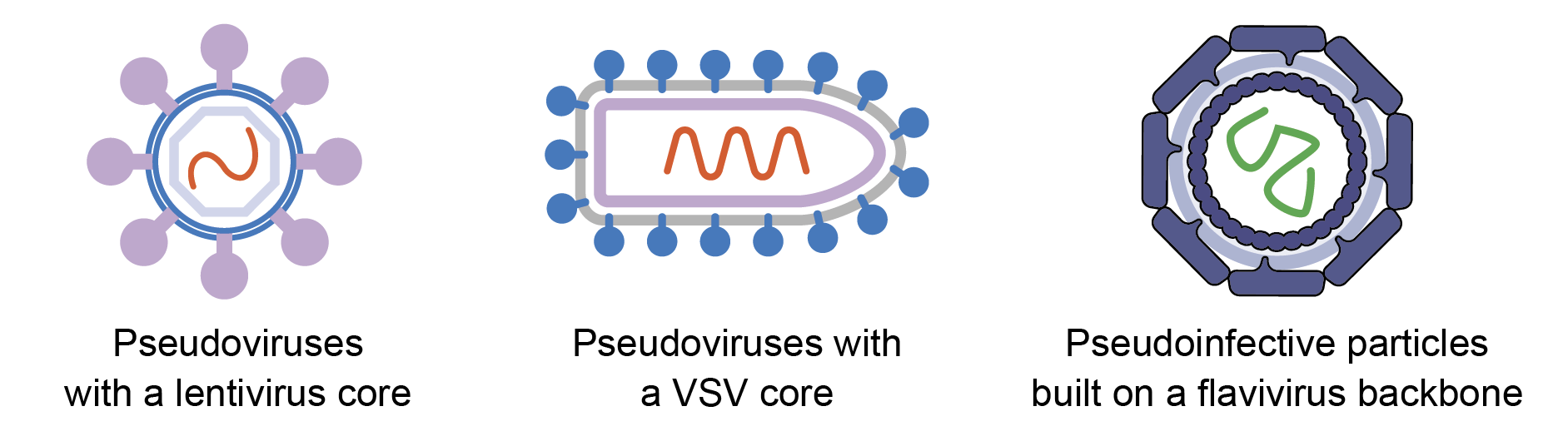
Our toolbox contains three core systems: lentivirus core, VSV core, and flavivirus backbone.
Sprinting for Hantavirus Tools
Just 28 days after viral sequences were released, our Andes hantavirus RVPs were ready to ship. In a stroke of luck, we were already well on the road to developing RVPs for Hantaan, a distantly related hantavirus. That gave us a head start on a pseudoviral system for presenting hantavirus surface proteins. Additionally, we decided to develop RVPs for the new Andes Switzerland strain in parallel with those for Andes Epuyen, the closest relative from earlier infections. With access to Switzerland, Epuyen, and Hantaan sequences, researchers would be better able to characterize antibodies with broad cross-neutralizing activity.
Once we had the sequences, we were able to quickly design and generate expression constructs for viral surface proteins. "Finding the sequence and ensuring that the lab team gets the best expression of viral surface proteins is a foundational process,” notes Larissa Osterbaan, PhD, Research Scientist on our Molecular Biology Team. “We draw on our experience with a wide range of viral families to select the best expression strategy for novel virus surface proteins."
After researching the sequences and generating plasmids for expressing surface proteins on a VSV core, we followed our protocols to optimize production conditions for high-titer particle generation under our ISO 9001 certified quality management system. All three of these hantavirus pseudovirus products are available to order.
Immediately after the RVPs passed quality control, we were able to use them to test a collaborator’s antibodies from past hantavirus infections for virus-neutralizing cross-reactivity against the new Switzerland strain. Providing neutralization results in just 48 hours from infection to readout, these experiments generated data that was immediately helpful in steering antibody development efforts.
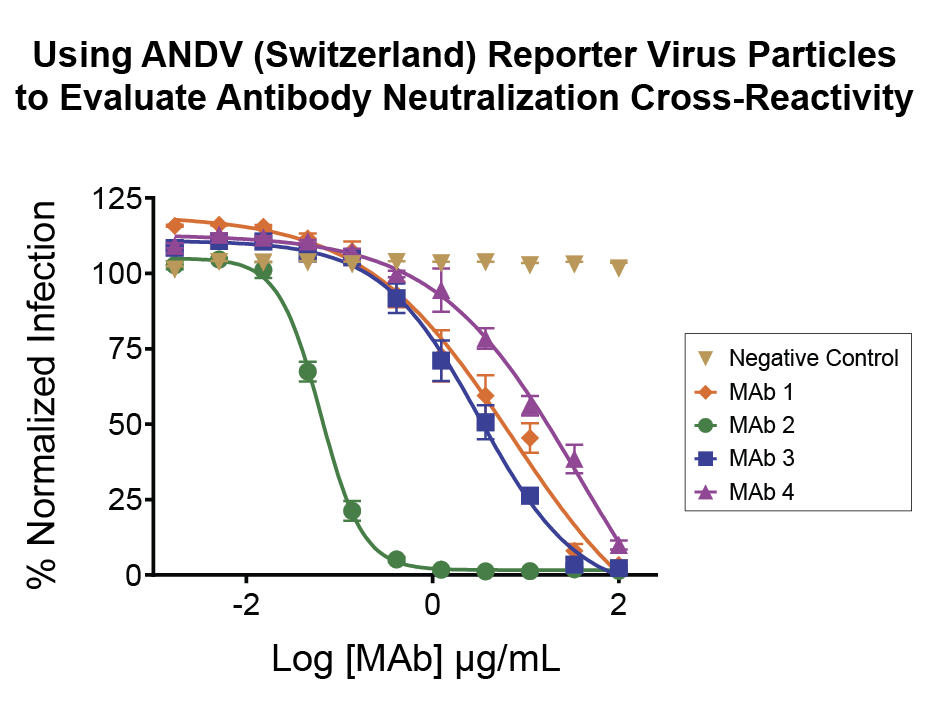
Application: Neutralization of Andes hantavirus infectivity by monoclonal antibodies. Antibodies were incubated with ANDV Switzerland strain RVPs, followed by application of the RVP–antibody mix to HEK-293T target cells. Infection of the target-cells by RVPs was measured as target-cell GFP expression by flow cytometry. MAb1-4 are known neutralizers of older Andes hantavirus strains and inhibit infection as compared to a negative control antibody.
A Rapid Response to Bundibugyo
As we were winding down our hantavirus sprint and final QC testing, the declaration came that the Bundibugyo ebolavirus outbreak in the Democratic Republic of Congo was a public health emergency of international concern. The virus had already infected hundreds of people, and it was spreading rapidly. A challenge to the response: any available ebolavirus vaccines and therapeutics had been developed against other viral species. Cross-reactivity and cross-protection studies were essential for understanding how to protect those vulnerable to infection.
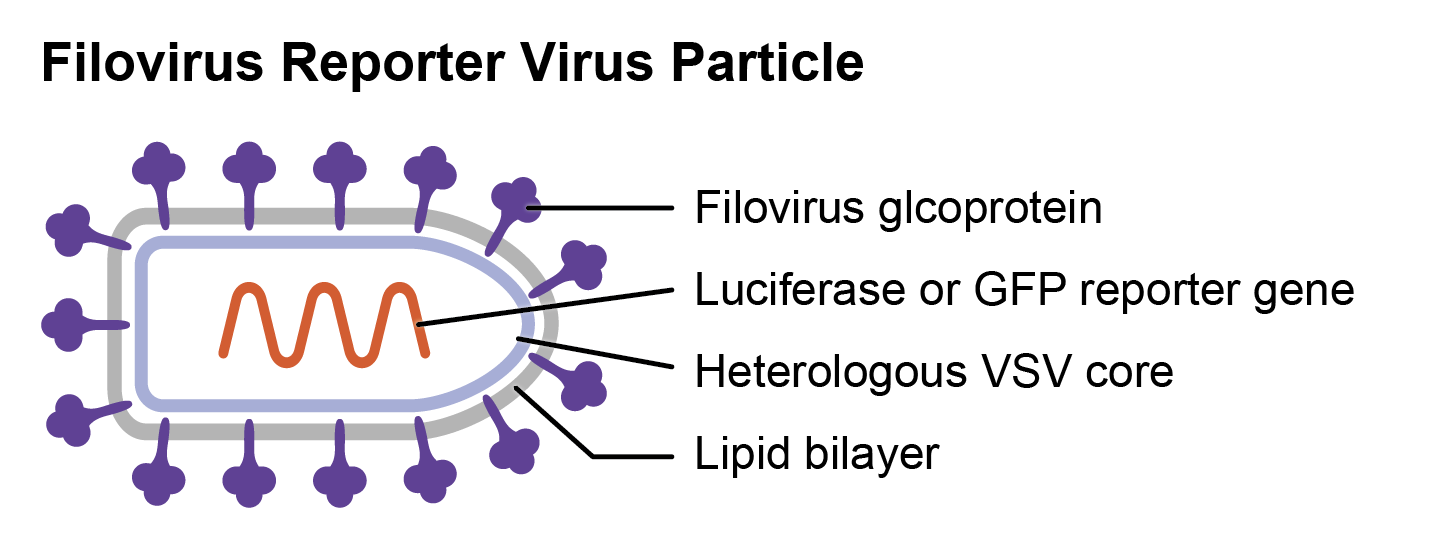
With this outbreak, we again had a head start on the development of pseudotype particles—one of the benefits of our broad catalog. We already had well-characterized RVPs in our catalog for related filoviruses (EBOV, SUDV, and MARV), and we had multiple filovirus experts on the team. We rolled up our sleeves and got to work, following the same general process we began just weeks earlier for generating hantavirus RVPs. Though the work took extensive planning, the team was well prepared. Jennifer Kilgore, Senior Project Manager, noted, “Through working on some challenging viruses, our team has built robust systems for new product development. While balancing the hantavirus sprint, advancing tools for Bundibugyo research, and supporting our ongoing work in close succession was challenging, this type of sprint reflects our team’s commitment to outbreak response and our ability to pivot quickly to meet customers’ needs.”
Less than a month after sequences were published, Bundibugyo ebolavirus RVPs for the historic 2007 outbreak were ready to ship, and RVPs for the current outbreak were in advanced development. These essential BSL-2 safe reagents are now in researchers’ hands, including in key labs in central Africa, where they’re being used to test cross-neutralization activity of vaccines and antibodies.
If you’re interested in learning how filoviruses infect cells and how to choose tools for studying them, check out our article Ebola and Marburg Pseudovirus Biology and Applications. You can also learn more about our Filovirus RVPs.
Supporting New Projects: From Emerging Pathogens to Custom Needs
The overlapping Andes hantavirus and Bundibugyo ebolavirus outbreaks presented a challenge that tested our team’s abilities to deliver new reagents on highly accelerated timelines while maintaining our rigorous quality standards. By combining our established pseudotype platforms, deep mechanistic expertise on filoviruses, and robust quality systems, we were able to place critical BSL-2 safe reagents in researchers’ hands within weeks of sequence release. We’ll continue monitoring emerging pathogens of concern and providing essential tools to teams working on infectious disease response and preparedness. In future outbreaks, we’ll be ready with tools as quickly as possible, so be sure to check in with us when the time comes and initiate a pre-order.
The same capabilities that enable rapid outbreak response are also available through our custom virology development services. Whether you need a pseudotype of a new virus, a customized version of a catalog product, or a specialized VLP for a unique application, our team can apply our well-tested workflows to your project. From sequence design and construct optimization through production, assay development, and quality-controlled delivery, we partner with researchers to create fit-for-purpose reagents tailored to their scientific goals. We enjoy tough problems and working alongside customers to develop the assays they need to advance their programs.
While our team is physically distant from these latest outbreaks, we are proud to be able to support the efforts to protect global citizens from these and other deadly viral pathogens.
Contact Us
If you have questions about custom projects or catalog reagents, please reach out.
Form not loading? Contact us here