
In this article:
- Filovirus Pseudotypes Are a Safe Alternative to Working with Live Ebola and Marburg Viruses
- How Filovirus Pseudoviruses Work
- Ebola Pseudoviruses Faithfully Model Viral Entry and Neutralization Mechanisms
- How to Choose the Appropriate Filovirus Pseudotype or VLP
- Steps for Successful Pseudovirus Assays: Quality and Optimization
- Our Ebolavirus Expertise
- Our Filovirus Products
Key Takeaways
- Filovirus pseudovirus assays accurately model live virus entry behavior and enable screening for neutralizing antibodies and filovirus entry inhibitors safely in BSL-2. Glycoproteins presented on the pseudovirus surface mediate the complete viral entry process, just as they do for authentic virus.
- System selection for filovirus assays should be driven by the specific research objective.
- Pseudovirus assay protocol optimization—including quality control, conformational antibody verification, and documentation—and cell handling are critical to filovirus assay reproducibility.
Filovirus Pseudotypes Are a Safe Alternative to Working with Live Ebola and Marburg Viruses
Ebola and Marburg viruses are deadly, challenging to study, and risky to work with. Filovirus pseudoviruses (also called pseudotypes) are a BSL-2 safe, non-replicative alternative to working with live filoviruses.
Filovirus pseudoviruses avoid the need for BSL-4 containment while preserving the essential viral biology required for many applications centered around viral entry. It is well-established in the literature that these models produce assay results comparable to those of live filoviruses. Yet filoviruses also have complex biology, making well-designed models, optimized assays, and expert support essential. This page details several important factors you should be aware of before establishing your own Marburg or Ebola pseudovirus assay.

Because filovirus pseudovirus models are replication-incompetent, they are safe to use in BSL-2 labs.
How Filovirus Pseudoviruses Work
The central operational challenge of filovirus research is that you need a BSL-4 lab to work with the live virus. Filovirus pseudotype particles are designed to solve this problem. Because they are replication-incompetent, they cannot spread or cause disease. That means they are safe to use in a standard BSL-2 laboratory.
On their surface, filovirus pseudotypes display the same filoviral envelope protein (glycoprotein, or GP) that live viruses use to enter cells. Inside, they carry a reporter gene—typically luciferase or GFP—that produces a measurable signal within 24-72 hours of infection. Because they have no viral genome and do not replicate, they enable reliable filovirus neutralization assay development without BSL-4 containment.
As established in the literature, Ebola pseudoviruses show tight correlation with live Orthoebolavirus neutralization assay results, enabling reliable assessment of multiple sample types including antibodies and serum.
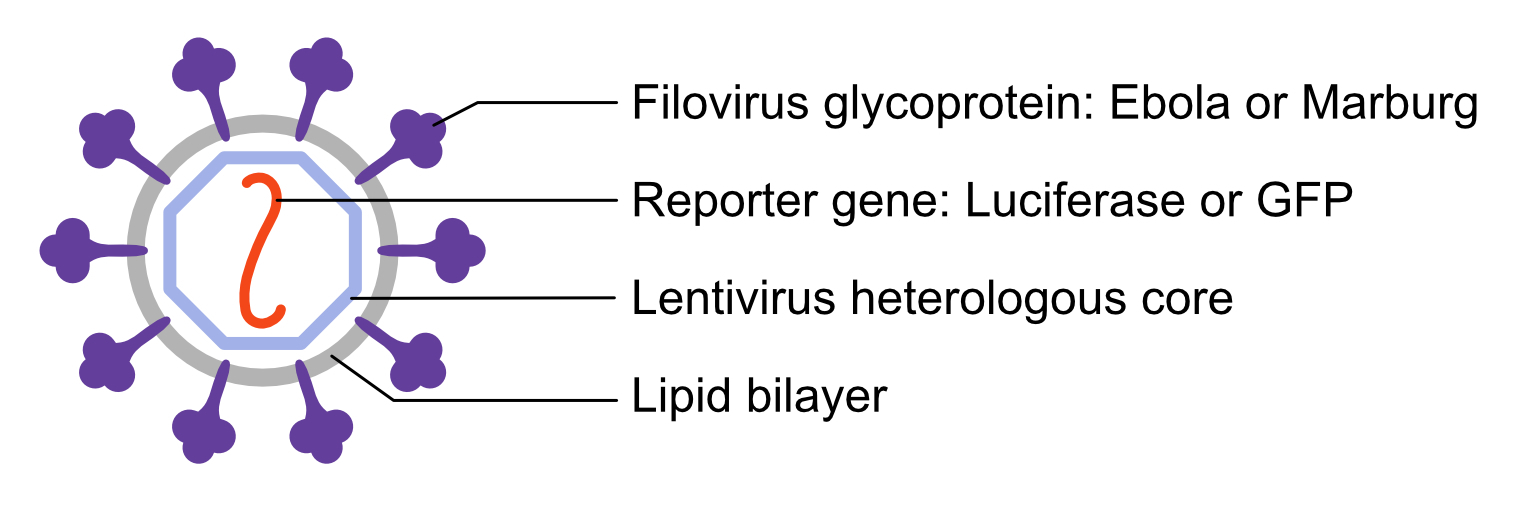
A filovirus pseudotype model

Pseudovirus neutralization assay general overview
Ebola Pseudoviruses Faithfully Model Viral Entry and Neutralization Mechanisms
Marburg and Ebola pseudoviruses are effective tools because they faithfully model how the authentic virus binds to cells, enters them, and responds to neutralizing antibodies. The following section provides an overview of the filovirus species known to infect humans and the molecular mechanism by which they enter cells.
Within the Filoviridae family, viruses of two genera are known to cause disease in humans. Orthomarburgvirus includes one species (Marburg virus, MARV), and Orthoebolavirus (also known as ebolaviruses) includes six species. Within the ebolaviruses, Zaire Ebola virus (EBOV) and Sudan virus (SUDV) have caused the largest documented disease burden. Bundibugyo virus (BDBV) has been associated with a single documented outbreak prior to 2026.
For all filoviruses with mammalian tropism, glycoprotein (GP) is the sole protein involved in viral entry and fusion, and therefore the critical target for neutralizing antibodies and filovirus entry inhibitors. With sequence divergence of up to 76% in their GP amino acid sequences, Orthomarburgvirus and Orthoebolavirus species differ significantly in their epidemiology and therapeutic susceptibility.
Percent identity matrix of filovirus glycoproteins
| Strain | MARV | EBOV | BDBV (2026) | BDBV (2007) |
|---|---|---|---|---|
| RVP-1501_MARV_01Uga2007_GP | 100.00% | 33.28% | 33.72% | 32.89% |
| RVP-1401_EBOV_Mayinga76 | 33.28% | 100.00% | 67.42% | 66.82% |
| PP_006XCJJ.1_BDBV_2026DRC_GP | 33.72% | 67.42% | 100.00% | 98.22% |
| YP_003815435.1_BDBV_2007UGA_GP | 32.89% | 66.82% | 98.22% | 100.00% |
Viral entry mechanism
- Initial Binding and Macropinocytosis: Orthoebolavirus (including Zaire and Bundibugyo Ebola) GP binds broadly to cell-surface lectins and pattern-recognition receptors, initiating viral attachment. The virus is then primarily internalized via macropinocytosis rather than receptor-mediated endocytosis, permitting entry into cells lacking conventional surface receptors.
- Intracellular Trafficking: Internalized Ebola is trafficked to late endosomal compartments. This trafficking is essential for exposing GP to the cell’s proteolytic environment.
- Proteolytic Maturation: Cysteine proteases cathepsin B and L cleave GP during endosomal trafficking, exposing the fusion loop and rendering GP fusion-competent. GP1 mediates binding to the intracellular viral receptor; GP2 contains the hydrophobic fusion loop that enables the virus to undergo fusion and infect the cell.
- Receptor-Mediated Positioning: Once in the late endosome, GP1 engages NPC1 (Niemann-Pick C1 protein), a host cholesterol-trafficking protein. NPC1 enables positioning of GP2 to optimize fusion competence.
- pH-Dependent Fusion: Low pH in late endosomes triggers conformational changes in GP2 that expose the fusion loop. Full fusion occurs optimally below pH 5.5 and requires convergence of multiple factors: low pH, NPC1 binding, proteolytic maturation, and endosomal ion channels regulating pH and calcium.
How to Choose the Appropriate Filovirus Pseudotype or VLP
Filovirus pseudoviruses and virus-like particle (VLP) systems are useful in key applications for therapeutic and vaccine development, all centered on viral entry. But different applications may require different types of pseudoviruses, and there are some cases where pseudoviruses are not the most appropriate model system. The following guidance will help you choose the right tool for your project.Filovirus Neutralization Assay for Vaccine Testing and Seroprevalence Studies
Both VSV-core and lentivirus core pseudotypes are useful for vaccine immunogenicity and sero-surveillance studies. Vaccine immunogenicity testing measures immune responses in vaccinated individuals. Sero-surveillance involves testing serum samples for neutralizing antibodies to determine if members of a population have prior infection or immunity. One practical note: if your serum samples are from populations with high rates of antiretroviral therapy (ART) use, VSV-core pseudotypes give more reliable results. Some antiretroviral drugs interfere with the lentiviral-core system and could produce false positive results for neutralization.Filovirus Entry-Inhibitor Screening for Small Molecule and Antibody Development
Both VSV-core and lentiviral-core pseudotypes perform well for entry inhibitor screening, whether for small molecules or neutralizing antibodies that block viral entry. Entry inhibitors interfere with virus-cell binding, induce changes in host cells that prevent viral entry or trafficking, or may block fusion by stabilizing the viral surface protein. Because none of these functions involve replication, a pseudovirus system is a complete substitute for authentic virus.Filovirus Replication Inhibitor Screening Using Minigenome VLPs
Testing inhibitors that target viral replication, transcription, or virion assembly requires a system that replicates inside cells; filovirus pseudotypes are not sufficient. Ebolavirus virus-like particles (VLPs) with minigenomes are designed for this. These particles contain all the authentic structural proteins of the real virus and a minimal viral genome that replicates—but they produce defective particles, so they are safe at BSL-2. This system is more complex to establish, but it is necessary for this specific application.Quick Reference: Pseudotype Selection by Application
| Assay Application | Particle System | Additional Considerations |
|---|---|---|
| Vaccine efficacy or sero-surveillance | VSV-core or lentivirus-core pseudotypes | If serum from populations with high use of ART, prefer VSV-core |
| Entry inhibitor screening (small molecules, antibodies) | VSV-core or lentivirus-core pseudotypes | Both systems perform equally for entry assays |
| Replication or transcription inhibitor screening | Minigenome VLPs or authentic virus | More complex; requires active viral replication inside cells |
Steps for Successful Pseudovirus Assays: Quality and Optimization
Choosing the right tool is only the first component of a successful assay. Others include selecting a reliable reagent provider, ensuring healthy cells, and developing plate layouts and read strategies. The following information will help guide you in planning your filovirus pseudovirus assays.Begin with High-Quality Pseudovirus Tools
Pseudovirus quality can vary considerably, and those differences have real impacts for assay performance. Many labs choose to purchase pseudovirus, especially when conducting assays at large scale, or if they lack experience in preparing pseudovirus. If you are considering producing pseudotypes in-house, considerable optimization is likely to be required for high-titer viral particle preparations. Cell condition and quality of inputs are both critical factors—and areas where things can go wrong in viral preparation, especially with inexperience.
For the most accurate, reproducible results, be sure to carefully QC in-house preparations or source your pseudoviruses from a reputable supplier with defined quality management standards, supporting documentation, and optimized protocols. At Integral Molecular, we produce and test all Virology catalog products using ISO 9001 certified processes, ensuring lot-to-lot consistency and reproducibility. This saves our customers time. Particles arrive assay-ready because our team has already analyzed critical quality parameters including particle titer, infectivity, and proper presentation of the filoviral glycoprotein on the particle surface (if neutralizing antibodies are available).
Cell Culture Optimization
Cell health and propagation practices for target cells (the cells that will be infected by pseudovirus) substantially influence filovirus pseudotype assay results. Maintain target cells at an appropriate density (typically 70–90% confluency at time of infection), with high viability (>90% preferred), and at an appropriate passage number to maintain responsiveness to infection. Cell line variability across passages can produce significant assay drift, so passage tracking and periodic refreshing from low-passage frozen stocks is recommended.
Infection kinetics vary with cell culture conditions, growth phase, and temperature. Optimal infection windows for entry and neutralization assays typically occur 24–72 hours post-infection, depending on the reporter system (luciferase vs. GFP) and cell line used. Early time points may lack sufficient signal; late time points can compromise lab efficiency and increase the risk of reporter protein degradation. Assay windows should be empirically determined for each cell line and culture condition. All Integral Molecular pseudovirus products include protocols with optimized read windows.
Signal Optimization
Reporter signal optimization is critical for assay sensitivity and dynamic range. For luciferase-based assays, be sure to standardize substrate concentration, incubation time, and luminometer settings across experiments. For GFP-based assays, always document flow cytometry parameters (gating, voltage settings, compensation) and apply them consistently.Scaling Your Assay
Scaling to high-throughput assay formats requires careful attention to plate uniformity, incubation conditions, and temperature control. Assay miniaturization (from 96-well to 384- or 1536-well formats) can introduce edge effects and evaporative losses; these should be evaluated empirically. Our experts are available to support you with tips for dealing with these challenges.

Our Ebolavirus Expertise
We are ready to apply our filovirus expertise to your project. Our team brings extensive experience in filovirus assay development, with published peer-reviewed research on filoviruses and filovirus particle development. We are inventors on a patent for filoviral antigen design (US 20190381162 A1), and our expertise spans filovirus entry mechanism research, neutralization assay development, and BSL-2 filovirus model optimization for therapeutic screening.Our Filovirus Products
Integral Molecular offers Reporter Virus Particles (RVPs) for Marburg virus and Orthoebolavirus species (Sudan, Zaire, and Bundibugyo), enabling safe, BSL-2–compatible filovirus assays for therapeutic development. Our filovirus pseudotypes are produced under ISO 9001 certified quality management systems and are available as assay-ready reagents. Each lot is characterized for infectivity, particle concentration, and neutralization activity to ensure consistent performance across experiments. We also track lot-to-lot variation and storage stability to ensure particles are fit for purpose.
Our filovirus RVPs display antigenically correct envelope glycoprotein, and they carry built-in luciferase or GFP reporter genes, enabling neutralization and entry assay readouts within 24 hours. These filovirus assay reagents are optimized for high-throughput applications using standard detection instrumentation, reducing both timeline and resource requirements for therapeutic screening.
All of our filovirus pseudotype products are backed by established assay protocols and technical support from our experienced scientific team.
 ISO 9001 is a globally recognized standard for quality management systems (QMS) that encompass process controls, comprehensive documentation, plans for corrective action, and continuous improvement.
Contact Us
If you have questions about Filovirus RVPs or pseudovirus neutralization assays, please reach out.
Form not loading? Contact us here